
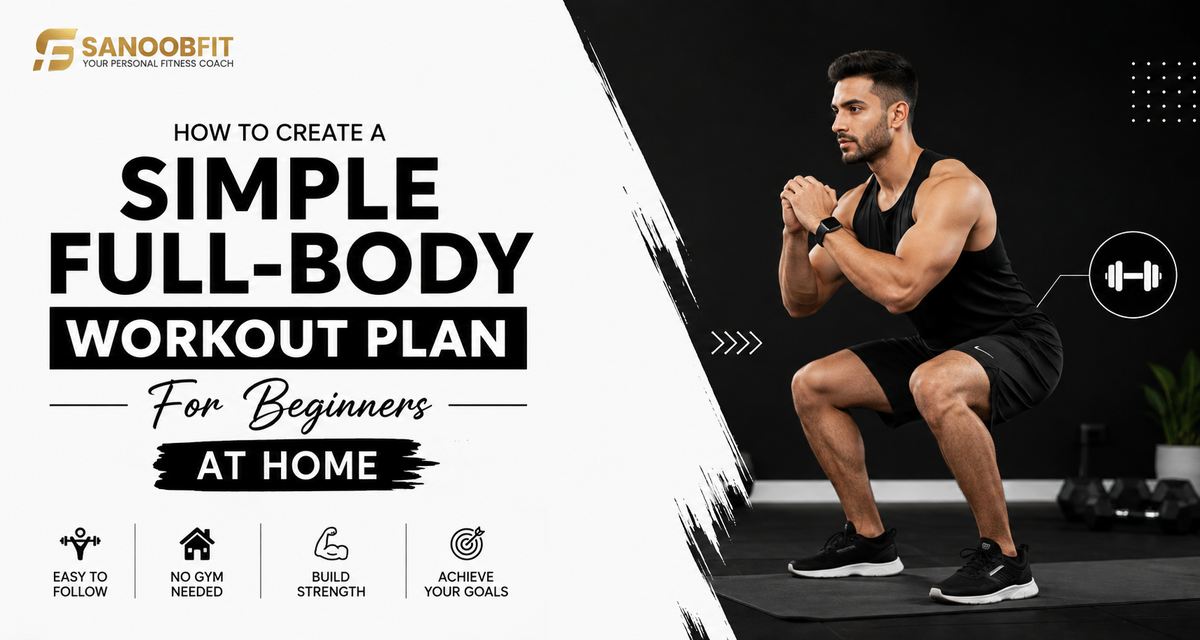
Starting a workout routine at home can feel confusing when you are not sure which exercises to choose, how many repetitions to perform, or how often you should train. The good news is that beginners do not need a complicated program. A simple full-body workout can target the major muscle groups while helping you build strength, mobility, endurance, and consistency.
The key is to start gradually, focus on proper technique, and choose exercises that match your current fitness level. This guide explains how beginners can create a practical full-body workout plan at home, even with little or no equipment.
What Is a Full-Body Workout?
A full-body workout is a training session that works multiple major muscle groups in the same session. A beginner routine can include movements that train the legs, hips, chest, back, shoulders, arms, and core.
For most beginners, 2–3 full-body sessions per week can be a practical starting point, with rest or lighter activity between training days.
Why Should Beginners Start With Full-Body Workouts?
A full-body routine is useful for beginners because it allows you to train several muscle groups without needing to exercise every day.
Some potential benefits include:
- Building basic strength
- Improving muscular endurance
- Supporting better movement patterns
- Developing exercise consistency
- Improving overall fitness
- Making efficient use of limited workout time
- Learning fundamental exercises
You do not need to perform dozens of exercises. A few well-selected movements can provide a strong foundation.
Step 1: Decide Your Main Fitness Goal
Before creating your routine, identify what you want to achieve.
Your goal might be:
- Building basic strength
- Improving general fitness
- Supporting weight management
- Increasing endurance
- Becoming more active
- Developing a consistent exercise habit
Your goal can influence exercise selection, workout intensity, repetitions, and progression.
For beginners, however, learning good movement technique and developing consistency should generally come before trying to maximize workout intensity.
Step 2: Choose Fundamental Movement Patterns
Instead of choosing exercises randomly, build your workout around basic movement patterns.
A beginner-friendly full-body workout can include:
Squat Movement
Squats train the muscles of the lower body, particularly the thighs and hips.
Beginner option: Bodyweight squats
Start with a comfortable range of motion and keep your movement controlled.
Hip-Hinge Movement
Hip-hinge exercises train the muscles around the hips and posterior chain.
Beginner option: Glute bridges
They are simple to perform at home and can help beginners learn how to engage the hips.
Push Movement
Push exercises work the chest, shoulders, and triceps.
Beginner option: Wall push-ups or incline push-ups
If standard push-ups are too difficult, start with an easier variation and gradually progress.
Pull Movement
Pulling movements generally train the back and arms. This category can be more difficult to train at home without equipment.
If you have resistance bands or suitable equipment, a beginner can include band rows or another safe pulling exercise.
Core Movement
Core exercises help develop strength and control around the midsection.
Beginner options: Dead bugs, bird dogs, or modified planks.
Choose a variation that allows you to maintain controlled movement.
Step 3: Keep Your First Workout Simple
A beginner does not need a 60-minute workout packed with exercises.
A simple session could look like this:
| Exercise | Sets | Repetitions |
|---|---|---|
| Bodyweight Squat | 2 | 8–12 |
| Incline Push-Up | 2 | 6–10 |
| Glute Bridge | 2 | 10–15 |
| Band Row | 2 | 8–12 |
| Bird Dog | 2 | 6–10 per side |
These numbers are general examples rather than a universal prescription. Your appropriate volume depends on your fitness level, exercise technique, recovery, and individual circumstances.
Step 4: Start With a Proper Warm-Up
A warm-up prepares you mentally and physically for exercise.
You can spend around 5–10 minutes performing easy movements such as:
- Walking around your home
- Marching in place
- Arm circles
- Gentle bodyweight squats
- Hip rotations
- Shoulder movements
The warm-up should gradually increase your activity level without making you tired before the main workout.
Step 5: Focus on Exercise Technique
For beginners, quality is more important than simply completing a high number of repetitions.
During each exercise:
- Start with a comfortable position.
- Move slowly and with control.
- Avoid rushing through repetitions.
- Maintain a stable posture.
- Stop if you experience sharp or unusual pain.
- Practice easier variations when necessary.
If you are unsure about how to perform an exercise safely, consider getting guidance from a qualified fitness professional.
Step 6: Choose the Right Workout Frequency
You do not have to work out every day to make progress.
A beginner could start with two or three full-body workouts per week. For example:
Monday: Full-body workout
Tuesday: Rest or light activity
Wednesday: Full-body workout
Thursday: Rest
Friday: Full-body workout
Saturday: Optional light activity
Sunday: Rest
The exact schedule can be adjusted according to your lifestyle and recovery.
Step 7: Give Your Body Time to Recover
Recovery is an important part of training.
Your body needs adequate rest between challenging workouts. Beginners should avoid increasing training volume too quickly simply because they want faster results.
Helpful recovery habits can include:
- Getting adequate sleep
- Staying hydrated
- Eating balanced meals
- Taking rest days
- Performing light activity when appropriate
- Gradually increasing training demands
If persistent pain, significant fatigue, or other concerning symptoms occur, seek appropriate professional advice rather than continuing to push through them.
Step 8: Progress Gradually
Once the exercises become easier, you can gradually make your workouts more challenging.
Progression can involve:
- Adding a few repetitions
- Adding another set
- Using a more challenging exercise variation
- Increasing resistance
- Improving movement control
- Reducing unnecessary rest when appropriate
You do not need to increase everything at once. Small, consistent improvements are easier to manage and sustain.
Can You Build Muscle With Home Workouts?
Yes, beginners can develop strength and muscle with home-based resistance exercises, particularly when the workouts provide an appropriate training stimulus and gradually become more challenging.
Bodyweight exercises can be a useful starting point. As your fitness improves, resistance bands, dumbbells, or other suitable equipment can provide additional progression.
The important factor is not whether you train at home or in a gym. Your routine should provide an appropriate challenge and progress over time.
Can Beginners Lose Weight With Home Workouts?
Home workouts can contribute to an active lifestyle and support weight-management goals. However, body-weight changes are influenced by overall energy intake, physical activity, sleep, lifestyle, and other individual factors.
Rather than relying on one workout to produce rapid changes, focus on building sustainable habits.
A combination of regular resistance training, appropriate physical activity, balanced nutrition, and adequate recovery can provide a more realistic long-term approach.
Common Mistakes Beginners Should Avoid
Creating a workout plan is only part of the process. How you follow the plan also matters.
Doing Too Much Too Soon
Starting with intense daily workouts can make recovery difficult and may reduce consistency.
Changing Workouts Every Day
Constantly switching exercises can make it difficult to understand whether you are actually progressing.
Ignoring Technique
More repetitions do not automatically mean a better workout. Controlled and technically sound movements should be a priority.
Skipping Recovery
Rest is not wasted time. Recovery helps you continue training consistently.
Expecting Immediate Results
Fitness improvements take time. Focus on gradual progress rather than unrealistic short-term expectations.
How Long Should a Beginner Home Workout Be?
A beginner full-body workout does not need to be extremely long. Depending on the exercises, rest periods, warm-up, and individual fitness level, 30–45 minutes can be enough for a practical session.
The quality and consistency of your training are generally more important than simply spending more time exercising.
How many exercises should a beginner do in a full-body workout?
A beginner can start with around 4–6 well-selected exercises covering the major movement patterns. The exact number can change depending on fitness level and available time.
Is 30 minutes enough for a full-body workout?
Yes. A focused 30-minute workout can be effective when it includes appropriate exercises and is performed consistently.
Can I do a full-body workout every day?
Most beginners do not need intense full-body resistance workouts every day. Allowing time for recovery can help you maintain consistency and gradually progress.
Do I need gym equipment for a full-body workout?
No. Many beginner exercises can be performed using body weight. However, resistance bands or dumbbells can provide additional options as you become stronger.
What should I do if an exercise feels too difficult?
Use an easier variation. For example, you can perform wall push-ups before progressing to incline or floor push-ups. The goal is to choose a version that allows controlled technique.
When Should You Consider Professional Fitness Coaching?
If you are unsure how to structure your workouts, have difficulty staying consistent, or want a program designed around your specific goals, professional coaching can provide additional guidance.
An online fitness training in Dubai can be useful for people who want structured fitness guidance while training according to their own schedule and location.
For people who prefer training at home with direct professional support, a Home Personal Trainer Dubai service may also be an option, depending on availability and your preferred training format.
Final Thoughts
Creating a full-body workout plan at home does not have to be complicated. Start with fundamental movement patterns, choose exercises appropriate for your current ability, keep your sessions manageable, and gradually increase the challenge as you improve.
Most importantly, focus on consistency. A simple workout routine that you can follow regularly is often more useful than a complicated program that is difficult to maintain.
Sanoobfit provides fitness guidance through online coaching with Muhammed Sanoob, helping individuals approach their training with greater structure and flexibility.